Loneliness: From Social Epidemic to China’s Next Economic Engine
How the "Are You Dead Yet?" app and Gen Z's solo-living trends are fundamentally rewriting the nation's social contract.
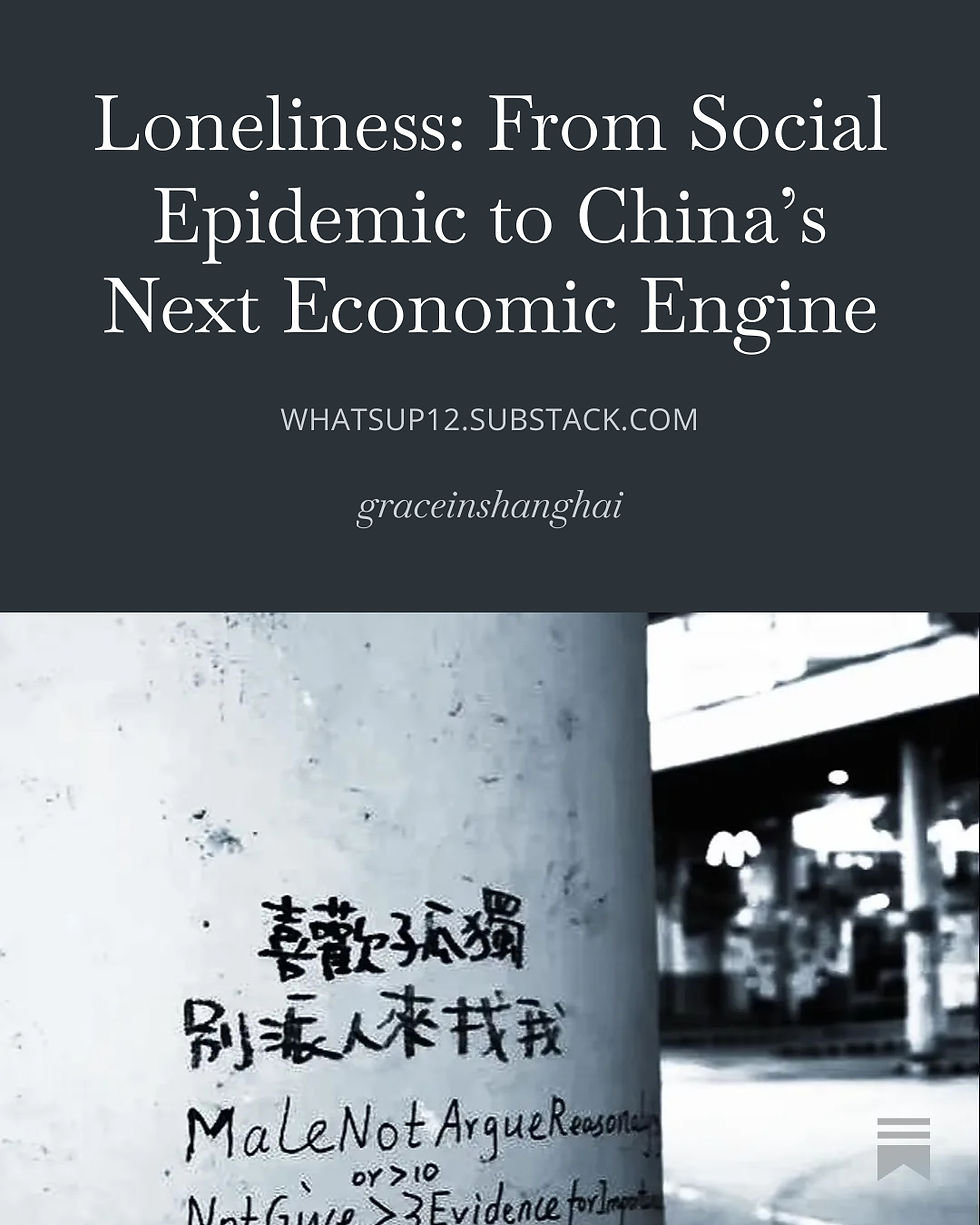
In 1994, we all laughed at the “lonely soul.” Back then, there was a well-known anthem, Shameful to the Alone (孤独的人是可耻的) by the rock star Zhang Chu 张楚. But as we entered 2026, an app called “Are You Dead Yet 死了吗?” went viral on China’s Apple Store, ranking at the top of the paid-app charts for weeks. This represents a drastic shift in the mindset of Chinese society: moving from the avoidance of loneliness to a blunt, raw confrontation with the reality of dying alone.
When looking closer, this shift reflects how Chinese social dynamics have been upended by rapid, non-stop economic growth over the past decades. The traditional Chinese family structure, centered around the Confucian ideal of "five generations under one roof," has evolved in the blink of an eye,first to the modern nuclear family, and now to the post-modern solo living style. According to JP Morgan, China’s average household size has shrunk from 4.41 persons in 1982 to 2.62 in 2020. Single-person households are now the second-largest household type, accounting for 25.4% of the total. What is particularly noteworthy is the explosive increase in the 25–29 age group choosing to live alone; the share of this cohort living solo surged from 5% to 12.8% by 2020. However, the “Silver Generation” (those aged 65 and older) still occupies the largest proportion of this single-family structure, at 15.7%.
Being alone is a decision, shaped partly by circumstance and partly by personal intention.
It is perhaps not unexpected that the younger generation is choosing to delay marriage and live alone. Tremendous economic pressure and uncertainty act as dominant forces, stressing young people out and forcing them to prioritize their careers at the cost of pursuing love or starting families of their own. This is solidly supported by convincing data: in 2024, only 6.1 million couples registered for marriage in China, marking the lowest level in 47 years. Meanwhile, the average age for a first marriage has been pushed back to 30 nationwide—and even past 32 in first-tier cities like Shanghai—a stark six-year delay compared to 2016. Aside from economic factors, rising individualism and booming feminism further propel this movement, turning a once "abnormal" lifestyle into a new normal that is widely accepted, and even embraced, by the younger generation.
Credit: RedNote
Loneliness is an epidemic in scale, and it needs to be combated differently.
This life choice brings unlimited freedom to individuality-driven Gen Zers, but it also drags them into a pinnacle of unprecedented loneliness. It has morphed from something "shameful" into a reality that requires a meticulous strategy to navigate gracefully.
An “International Loneliness Scale” diagram has become incredibly popular on Chinese social media platforms like Xiaohongshu and Douyin, used to diagnose how lonely a person is when living alone. It features ten levels, ranging from Level 1 (grocery shopping alone) to Level 10 - the breakdown level - undergoing surgery alone. Each level escalates from simple daily rituals to life crises involving serious illness.

Credit: Xiaohongshu
However, the 2025 Gen Z Loneliness Index Report by the Just So Soul Research Institute revealed that the intensity of Chinese youngsters’ loneliness differs from this international diagram. For Chinese Gen Zers, going to karaoke alone, eating hot pot alone, or even going to the hospital alone are not perceived as particularly lonely. What they experience as "truly lonely" are the quiet moments of regretful reminiscence, or having no one to console them when facing major setbacks or heartbreak. For them, the deepest pain of loneliness is a form of psychological and social death—the sense that no one can truly understand them or provide emotional support at the most critical moments. It is a sobering revelation that the root of loneliness in China lies in a lack of intimacy and true connection. This condition is not accidental; it is the outcome of a generation collectively prioritizing economic stability and individual freedom over intimate relationships. What they long for is success, security, and freedom—but what they truly need is genuine intimacy and completeness.

Data Credit: 2025 Gen Z Loneliness Index Report by Just So Soul Research Institute. Image Credit: Xiaohongshu
Real-life strategies for coping with loneliness have given rise to a booming “loneliness economy.”
The book The Lonely Society by Japanese scholar Atsushi Miura is widely discussed in China and regarded as a guidebook for understanding this epidemic. Many of the book's insights, based on Japanese society, ring true for today’s China. Both countries share similar social disruptions, accompanied by disillusionment and lifestyle changes among the youth. But the solutions differ, shaped by different cultures, technologies, and levels of digital immersion.
First, AI and digital immersion—including doomscrolling, short videos, and gaming—are the top choices.
As a hyper-online, digital-savvy tribe, the Chinese turn to technology first for any solution, including loneliness. According to the 2025 Gen Z Loneliness Index Report, digital immersion is the most efficient temporary cure for warding off loneliness.
Vertical drama, a super-addictive entertainment format born in China, has captivated countless lonely hearts and is now being exported overseas. While vertical drama is for the masses, gaming is more targeted toward the younger generation. Statista reports that China is the world’s most lucrative gaming market, with approximately 674 million players spending an average of 483 yuan (around USD 70) per person. Mobile games have become the industry pillar, contributing over 70% of sales revenue. Love and Deepspace (恋与深空), launched in 2024, swept the market by filling the void of young, lonely souls longing for intimacy with its mix of romantic fantasy and sci-fi. This indicates significant untapped potential as AI becomes more central to companionship products, especially when infused with Chinese cultural aesthetics.

Data Credit: 2025 Gen Z Loneliness Index Report by Just So Soul Research Institute. Image Credit: Xiaohongshu
Secondly, there is a tendency to seek collective yet momentary emotional bonding through “lightweight” social connections.
As intimate relationships are seen as too risky or "high stakes," Gen Z is looking for new ways to connect with like-minded people to share hobbies. This is known as dazi culture (搭子文化,partnering up for light socializing). Xiaohongshu provides the perfect platform for these momentary partnerships. This bonding is low-burden and instrumental; there is no need to feign intimacy or probe into personal lives. It is a perfect solution to cure loneliness while maintaining privacy and personal space. From a brand perspective, communities built around dazi culture represent a new pathway to connect with consumers. Lululemon is a compelling example, cultivating engagement through three tiers of community activities: store-based rituals, regional events, and large-scale urban gatherings. Most are free and easily accessible via their mini-program, Hot Sweat Life (热汗生活).
Lastly, an ecosystem for solo living is being built—from daily activities to handling life crises like sickness and death.
Savvy brands have launched products for the solo lifestyle, from one-person cookware to "eat-alone" restaurant spaces. Even McDonald’s outlets in China have recently introduced dine-in seats designed specifically for solo diners.
Also worth mentioning is the booming pet economy. Goldman Sachs reported that China’s pet population surpassed the number of children under age four for the first time in 2024. By 2030, the number of pets will be roughly twice that of young children, reinforcing the truth that young Chinese would rather have a furry companion than a baby.
As the single-person household becomes China's second-largest family pattern, society is paying more attention to the risks. The news of a single woman who died at the end of 2025 because she could not save herself despite having savings sparked heated discussion about the risk of "dying alone." This is why the app “Are You Dead Yet?” went viral in early 2026. It wasn't a coincidence; it was a panic-driven social reaction. The app pierces the deepest fear of lonely hearts: dying alone without anyone noticing.
The future is an ecosystem of products and services tailor-made for the single-family structure. This market will expand from a niche to a mega-market, driving social change and catering to the individual choices of young people. Loneliness is no longer something shameful or pitiful; it is a vibrant engine for economic growth.
In the end, I dedicate this article to my favorite Chinese rock song, Shameful to the Alone (孤独的人是可耻的) by Zhang Chu张楚. It’s a song I played repeatedly while weaving together this data, quietly reminding me of how the social meaning of loneliness has shifted, and how swiftly an era has slipped away.

credit: Xiaohongshu


Comments