From Order to Chaos: How Chinese Painting and Greek Myth Reveal Two Different Worlds
Recently, an art exhibition titled “A Thousand Years in the Clouds: Treasures from the Duo Yun Xuan Collection云藏千年” at the Shanghai Art Museum has been in full swing. One painting, in particular, has riveted my attention, not merely for its aesthetic beauty, but for its vivid and educational depiction of Confucian social structures. It is a visual representation of Confucian ethics, using specific avian species to symbolize the five fundamental human relationships. It acts as a "moral compass" rendered in ink.
This "Wulun Tu" (Painting of the Five Relationships) finds its cultural roots in the "Teng Wen Gong I" (滕文公上) chapter of the Mencius 孟子.

Credit: Wulun Tu, photographed by the author
In traditional Chinese culture, the number "Five" carries significant weight, representing a cosmic balance akin to the Five Elements. These five birds, often depicted in pairs, symbolize the five pillars of a harmonious society. This ideology was not limited to China; it became the moral backbone for other East Asian nations, including Korea and Japan.
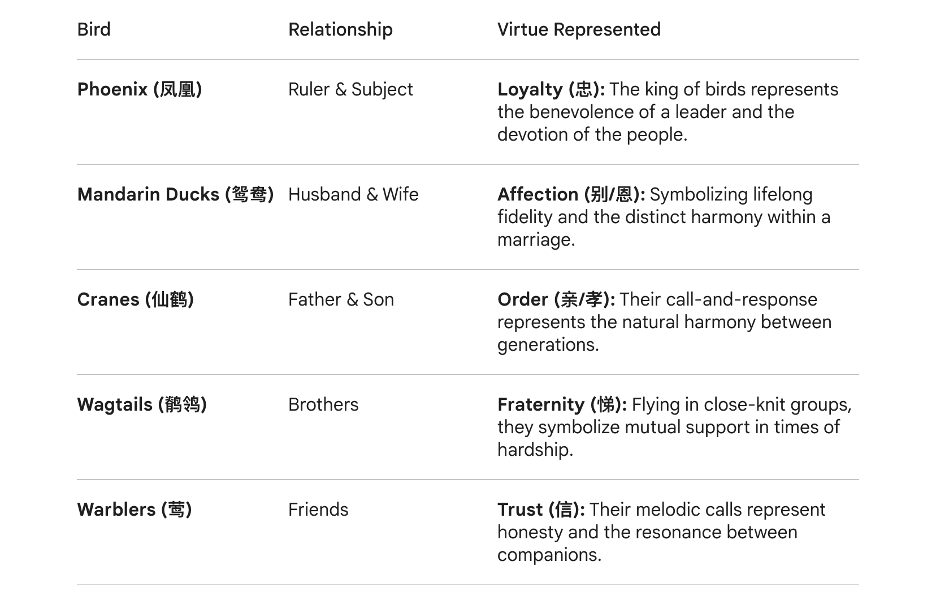
The Wu Lun Tu depicts an ideal world where every relationship is in its proper place. It reveals why, to this day, Chinese culture remains so deeply oriented toward Harmony (和谐).
The Mirror of Chaos: Greek Mythology
My curiosity was piqued by the stark contrast between this orderly vision and the chaotic world of Greek Mythology. Greek myths are notoriously volatile, filled with violence, betrayal, and crimes that shatter the very "five relationships" Mencius held dear.

A Scene From The Trojan Wars is a painting by Rafaelle Calliano
A friend once asked me, after we had a long and heated discussion, after reading Freud Among the Greeks by Pierre Varrod, “Why do Greek deities behave so much like humans? If they are immortal, why are they not like morally perfected sages revered in Chinese society?”
It was a thought-provoking question. Unlike the Confucian ideal, Greek mythology was never intended to constitute a "perfect" society. Instead, it reflects the real world: messy, violent, and driven by primal desires. While the Chinese "Wulun" seeks to prescribe an ideal state of being, Greek myths seek to describe the raw reality of human nature.
Final Reflection
This fundamental difference has shaped two distinct civilizations. The Chinese tradition pursues an ideal world of moral perfection, rooted in the belief that harmony can be cultivated through virtue. In contrast, the Western world, with Greek mythology and philosophy as its bedrock, acknowledges that the real world is defined by inherent uncertainty and chaos.
By accepting this chaos as a starting point, Western civilization moves away from the fantasy that human beings can entirely overcome their primal nature, with all its flaws and "sins." Instead, it focuses on the "How": how to construct laws, constitutions, and institutional boundaries to manage the natural disorder of humanity.
Ultimately, these insights are the fruits of my museum visit. From a single glimpse of a traditional painting to the gripping, often violent stories of ancient myths, I have begun to grasp the underlying truths that define these two civilizations and the profound differences in how they perceive the world.
This article is supported by Gemini, which helps me fill gaps in my knowledge of culture and civilization.


This is such a good analysis! Thank you!